

Tempest
Disassembled by Karl Stiefvater
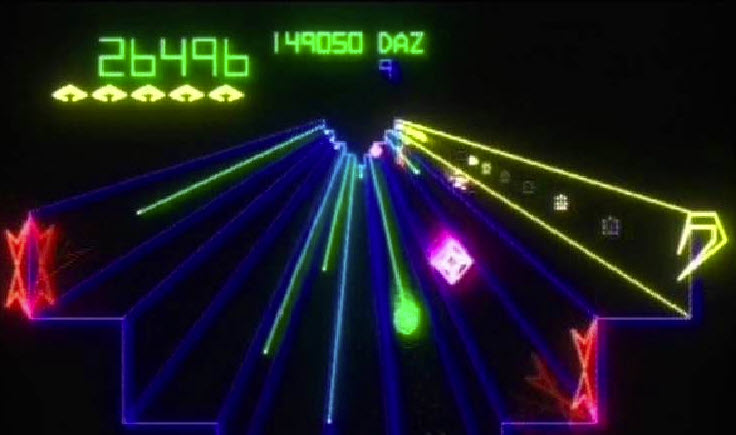
Tempest (Atari, 1981) is a first-person tube shooter drawn on a colour vector display. You look down a three-dimensional well rendered in perspective. Your ship — a claw-shaped Blaster — rides the near rim of the tube, and a spinner (a rotary knob) rotates it around the edge, one lane at a time. Enemies climb up the lanes toward you from the far end; you fire straight down the lane the Blaster sits on to destroy them before they reach the rim.
Each level is one tube of a fixed shape — a closed circle, a flat open line, a cross, a figure of several joined segments — divided into lanes around its perimeter. The geometry and the colour scheme change as you advance, cycling through a set of distinct shapes recoloured across many levels.
Several kinds of enemy work up the well. A flipper is the basic threat: it flips from one lane to the next and is deadly if it reaches your rim. A tanker carries two enemies and splits when shot or when it tops out. A spiker spirals up a lane leaving a growing spike behind it — a spike will not kill you on the rim, but it impales you during the end-of-level warp if you fly down a lane that still holds a tall one. A fuseball rolls along the rim between lanes, hard to hit and deadly on contact, and a pulsar sits in a lane and electrifies it, killing you if it pulses while you share the lane.
Your panic weapon is the Superzapper: the first press on a level destroys every enemy on screen, a second press kills just one, and it recharges each level. Clear the tube and you warp down the well to the next level — the view zooms through the geometry, and any tall spikes must be shot away first or they take a life on the way through. Points come from shooting enemies (harder types and deeper hits score more) and from clearing levels; bonus lives arrive at DIP-selected score thresholds. Lose all your lives and the game ends, with a chance to enter your initials on a high-score table that survives power-off.
Navigation
- Hardware — CPU, memory & I/O map, the spinner and buttons, the two POKEYs, the AVG vector generator, the math box, the EAROM
- Work RAM — the named work-RAM cells (0x0000–0x07FF)
- Main CPU code — the annotated 6502 disassembly
About this disassembly
This disassembly, RAM map, and game description were produced by AI and are verified against the original ROM and against MAME. The recovered code was checked to reproduce the ROM's own execution frame-for-frame, and the game model was confirmed by observing the real game running under MAME. It is offered here transparently, as AI work, precisely because it is machine-checked rather than hand-asserted — so verify it against that evidence. Project: https://github.com/qarl/arcade-js.
The disassembly covers the code reached from the machine's real entry points — the reset vector and the IRQ vector; ROM data tables (the tube geometry and colour tables, lookup tables, text) are shown as data. Sound comes from two POKEY custom chips, driven directly by the main CPU; there is no second processor, so this is the whole program. The Analog Vector Generator that draws the picture and the math box that projects the tube are hardware the 6502 feeds — a display list and a stream of coordinates — not code of their own.